Palm Sunday reveals: In a region scarred by genocide, many have abandoned Christ’s call for justice in favor of ‘foreign policy’. A faith once rooted in resistance now stands on trial.
Written by Myriam Charabaty on her Substack
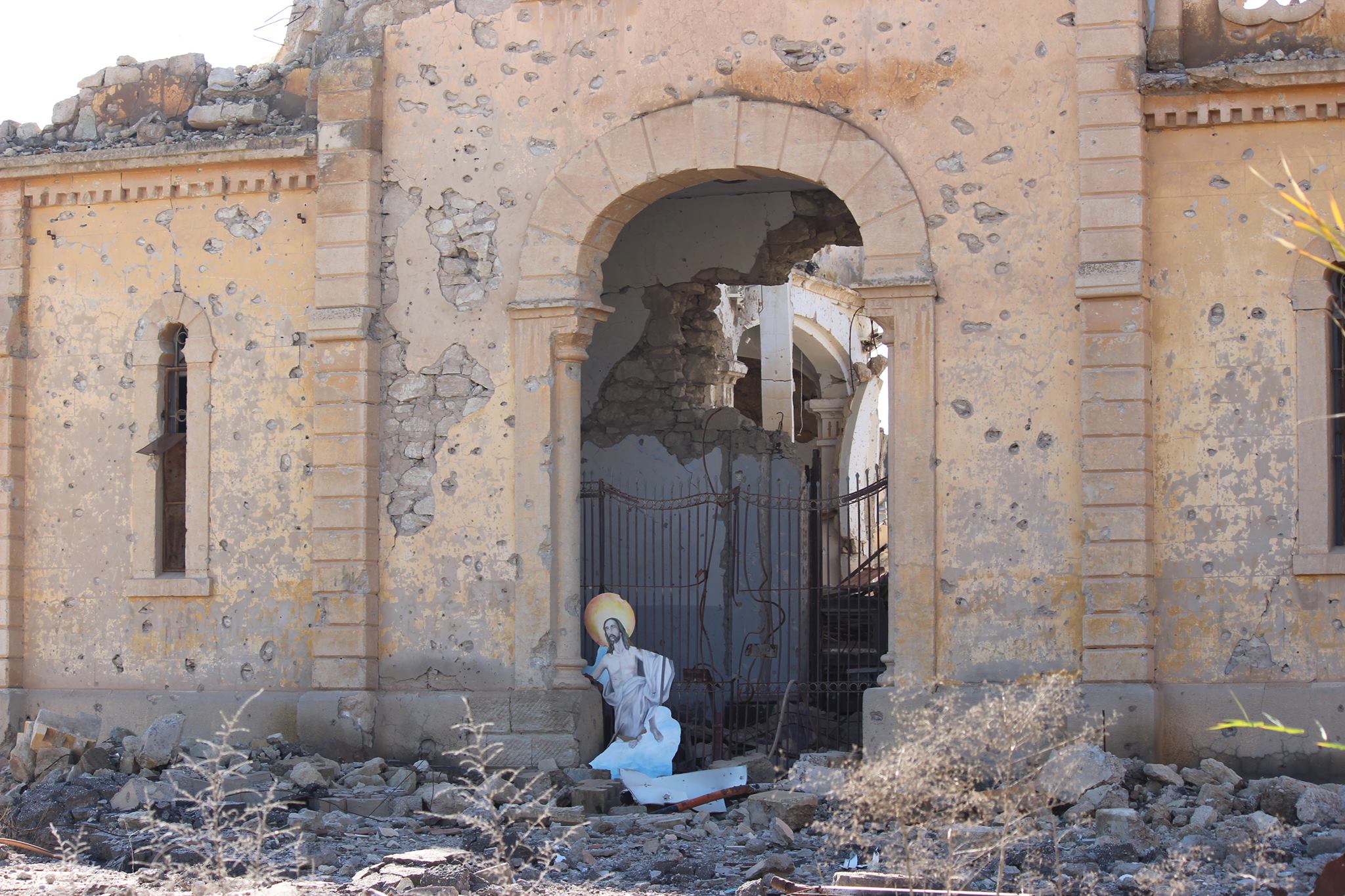
Deir Ezzor, Syria. Photo: Vanessa Beeley
It is Palm Sunday, April 13, 2025, and Christians, both Catholic and Orthodox, celebrate the triumphant entry of Jesus Christ into Jerusalem.
He who had already conquered death by raising Lazarus after four days in the tomb was now proclaimed King. The crowds gathered to welcome Him, waving palm branches and laying their cloaks on the road before Him. Each gave according to what they had. Some laid down simple cloaks, while others offered finer robes in a public gesture of reverence to the one they believed had come in the name of the Lord. Yet this very same crowd, later in the week, specifically on Friday, would shout, “Crucify Him!”
The Small World of the Masses
The same crowd that had heard of Christ raising Lazarus from the grave, an undeniable miracle, a direct confrontation with death itself, were the very ones who, days later, screamed for His crucifixion. This is not some tragic irony, nor is it a logical fallacy. It is a brutal revelation of how deeply humanity clings to the material and the familiar, even in the face of the divine.
By raising Lazarus, Christ shattered the natural order and revealed His divine nature. He gave the people every reason to believe, a clear and holy cause to recognize the Son of God standing in their midst. And yet, when the Romans seized Him, when Pilate paraded Him in chains, the same crowd recoiled. In their world, only the powerful deserve reverence. A bound man, a man without an army, wealth, or political influence, could not possibly be God. He did not fit their vision of glory, so they turned away.
They returned to their small lives, to the hierarchies they understood, where wealth commands respect and violence is mistaken for strength. They chose the empire. They chose the executioner. They chose comfort over truth, power over righteousness, and survival over salvation. They did not want a Savior. In fact, they wanted a spectacle. They wanted the one who appeared materially powerful.
In turn, Christ became flesh for the sake of truth, for the righteous, for justice, for the oppressed.
Christians Today Cry Hosanna While Crucifying a People
Christians today raise their palms and chant “Hosanna,” all while a people are crucified again and again in Palestine, Syria, Iraq, Yemen, Lebanon, Sudan, and beyond.
We are now in the second year of a live-streamed genocide. It began in 2023, and yet not a single major Church institution has found the courage to name the killer.
Not one Church has spoken with moral clarity, except the one that stands where it all began at the Holy Sepulchre in Jerusalem.
Neutrality in the face of this conflict is not justice. It is complicity. It is a calculated compromise that serves the interests of the militarily and economically powerful while trampling the holy commandments of Jesus Christ Himself. He did not call for silence in the face of oppression. He did not preach balance between the victim and the executioner. He called for truth, regardless of the cost. He stood with the outcast, the persecuted, and the dispossessed. And He did so knowing it would lead Him to the Cross. He entered Jerusalem fully aware of where the path would lead.
To claim His name while avoiding His path is not faith. It is betrayal.
The Curse of the Fig Tree
Even as entire families are wiped off the civil registry, even as children are starved and burned alive on camera, not one Church, not one bishop, not one clerical body has dared to invoke the doctrine of Just War in defense of the slaughtered. Not one has raised the banner of legitimate resistance in the face of genocide. Not one has declared that the defense of the innocent is a sacred duty.
Instead, the pulpits remain silent. The robes remain clean. The crosses are polished while the Cross, the living word of God, is desecrated. Those who claim to walk in His footsteps abandon an entire people to its fate. Some even become complicit in its eradication, as they have been for decades.
Here it is only right to recall how Christ cursed the fig tree and how He spoke in parables that exposed the priests and Pharisees of His time, those who clung to power instead of truth. And they knew He was speaking about them.
So it must be today. For what are these Churches, both the silent and incapacitated followers and their shepherds, if not leafy fig trees, full of signs of life, full of ritual and form, yet bearing no fruit?
I am no preacher. But it is evident that the leafy fig tree was cursed not for what it appeared to be, but for what it failed to be.
Is this not the judgment of Christ upon all who claim holiness yet do not live it? Those who preserve appearance but abandon substance? Those who bless the machinery of empire while turning their backs on the oppressed?
This is a lesson to all humanity. The curse falls upon the hypocrite, the one who displays outward signs of righteousness while harboring emptiness within. It is well known that the fig tree’s leaves usually appear alongside its early fruit. But this tree, though rich in foliage, was barren. It was deceptive in appearance, a living parable for every soul and every institution that cloaks itself in religion yet bears no fruit of justice, no offering of truth.
In other words, it is every believer who wears the cross but turns away from the Cross when it demands truth, sacrifice, and solidarity with the crucified of this world.
How to Understand the Suffering of People Today
The genocide in Palestine may have erupted in full view in 2023, but the genocide of the Arab people began long before. Some trace it back to the Balfour Declaration. Others to the Treaty of Versailles. Some would argue it began with the first Crusade. Because it has never mattered whether the Arab was Christian, Muslim, or Jewish. What mattered was that they were Arab and that they dared to hold on to their language, their land, their memory, and their pride.
For this, they were marked for elimination. Some were killed loudly with bombs. Others quietly, through siege, starvation, displacement, engineered migration, and slow erasure. Some fought back and they were labeled terrorists and extremists. Others surrendered and either met their fate or gained material rewards drenched in the blood of those they abandoned. Many chose silence, hoping compliance might earn them survival, only to discover that dignity, once forfeited, echoes hollow.
But we know what this is about. No surrender will save us. It will only make our death quieter, almost muted.
These are wars for geostrategic control, for resources, for imperial dominance. And the Western powers have made one thing clear. Any Arab presence that dares to assert its right to exist, its right to land, to history, to dignity, must be destroyed.
Annihilation Faces Us All, Yet Arab Christians Remain on the Sideline
So this is to my fellow Arab Christians:
This year is unlike those that preceded it in this part of the world. What was once dismissed as exaggerated talk of an existential threat to Christians in the region has now become a concrete and undeniable reality. Back then, many rejected the warnings voiced by some of us, those who saw the threat as imminent and necessary to confront, as if reading danger was itself a kind of delusion or deviation.
Yet despite this, the clergy and a number of spiritual leaders gathered multiple times to discuss the future of Christian presence in the region. Most agreed that this presence is heading toward decline, and that within fifty years, our churches may be reduced to museums. Still, even after reaching such conclusions, there was no real effort to pursue fundamental solutions, to wage the battle of existence, to define enemies, to embrace true allies, or to unite with the historical and natural lineage that connects us to the broader Arab world.
By contrast, there were those who did take up the existential fight. Hezbollah, with its worldview and direction, has for years waged a battle not just for Islamic or Arab identity, but for Christian presence as well. Because the Christian presence in this region is not marginal in the greater Islamic context of the Ummah. It is an integral component and a vital aspect of its religious, cultural, social, and historical identity. It is embedded in the core of the Arab fabric.
Yet Christian retreat predates all this. Today, the historic strongholds of Christian presence, in our wounded Levant and our occupied Jerusalem, are under assault by murderers and tyrants who falsely raise the banner of defending the oppressed. In reality, it is only our brothers from the original Muhammadan tradition, those who have remained true to its essence, who stand with the oppressed, far from sectarianism and political opportunism.
This year, then, marks a defining moment. If the Christians of the East do not recognize the signal now, there may never be another opportunity. And I, in my personal capacity, bear witness that our Arab identity, in all its richness and plurality, is under existential threat and that the battle to preserve it is a unified one.
We will continue walking behind the caravans of the resistance and the martyrs until our churches are returned to us and their bells ring once more, ringing out with pride in our belonging and mourning for those we have lost. From the most sacred martyr, Sayyed Hassan Nasrallah, to every soul who walked the path of love, dignity and resistance.
Conclusion: Either We Bear Fruit or We Are Cast Aside
Palm Sunday is not a ritual to be repeated. It is a reckoning. Either the Church bears fruit today and returns to its true calling, or it withers like the fig tree Christ condemned. Faith without conviction is betrayal. Holiness without justice is a hollow performance.
We must confront a hard truth. The Cross has not always been a symbol of salvation. Too often, it has been wielded as a banner of conquest. From the scorched gates of Jerusalem during the Crusades to modern invasions cloaked in the language of freedom, the name of Christ has been raised over the ruins of Eastern peoples. Today, that betrayal continues — not through swords, but through silence. And silence, in the face of atrocity, is not neutrality. It is complicity.
A Christian who refuses to reckon with this history, and who fails to answer it with action, is not defending the Cross. He is reenacting the crucifixion of Christ.
If the bells do not ring today in warning, they will toll tomorrow in mourning.
If we do not carry the Cross alongside the crucified in Gaza, Jerusalem, Syria, Lebanon, Iraq, and Yemen, then wearing it around our necks is nothing more than ornament.
If we cannot see that a Church that betrays the poor and abandons the oppressed is not the Church of Christ, but the same temple whose tables He overturned,
Then we stand at a threshold.
Either we bear fruit, or we are cast aside.
Either we reclaim the Cross as a testimony to truth and a burden for justice,
Or we face the judgment that fell upon the fig tree — not because it lacked leaves, but because it failed to bear fruit.
***

 The Wall Will Fall